December 31, 2019
This article has been reviewed in accordance with our editorial policy.
Heating a tiny house may prove to be more involved than it sounds. With so many options it can be difficult to determine which option is best for you.
So, how do you heat a tiny house? There are several options for heating a tiny house. One of the most common is a mini split, this is similar to central air and heat, but it is a single unit built for a large room. Many tiny houses also have a wood stove as a primary source of heat, especially for those that are off-grid. There are several other options as well.
My husband and I have been living tiny for almost 4 years now and we want to share our knowledge with others. We have used a few different options for our heat sources, so let's look at the pros and cons.
On-Grid Systems for Primary Heat
Mini splits are one of the most common heating methods for tiny houses due to their convenience and simplicity, especially for those on the grid.
When getting a mini split for a tiny house you should get a SEER rating of 20 and above. This is the efficiency rating for the unit and anything less than that is not recommended.
Important Note: If you are using your mini split for heat in the winter you will need to select the "follow me" mode on the remote and leave it at counter top height. The mini split will automatically turn off when the air around it reaches the temperature you set. Since these units are installed near the ceiling and heat rises, they will cut off when your house is still very cold. Selecting the "follow me" mode means that the mini split will turn off when it reaches the correct temperature around the remote.
Mini splits are most commonly known for their convenient air conditioning in tiny houses. However, most mini splits also offer heat as well. These are simple, sleek, convenient and easy to use.
You can set a temperature or a time to turn on and leave it alone. It is the most similar to central heat and air that a tiny house can get, since the house would be too small to actually install the central heat and air ducts.
They are very attractive and modern looking as well. They look like a white box placed up higher in the room. These are in most tiny houses on wheels, but other tiny houses use them too.
The cost ranges on mini splits, it is better to spend a little more on a nicer one rather than trying to cut costs here. The cheaper ones may look similar to the costly ones, however they will use more power.
The downfall of mini splits is their power usage. Whether you are concerned about your environmental footprint or your solar power, a mini split will use a lot of power.
Off-Grid Systems
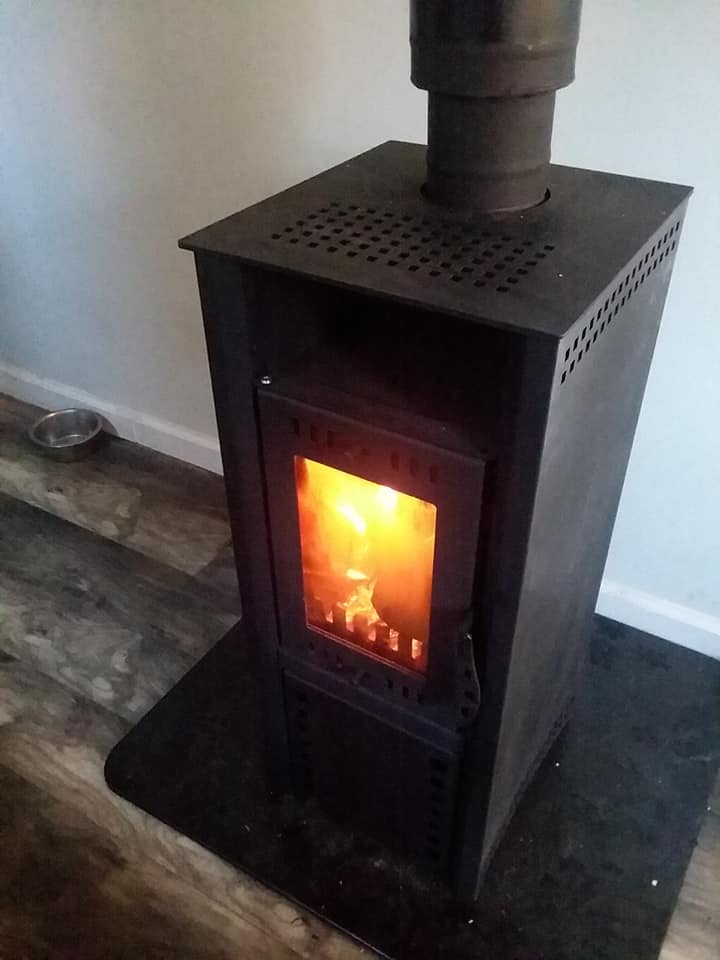
Recently, a few companies have been making tiny wood stoves perfect for tiny houses. They are small and simple and people love them. But they are not perfect. They are pricey (around $1,000) and you have to be sure to maintain your fire constantly.
Also these stoves have very small stove pipe, which is extremely hard to get, you will likely have to order it from those companies. Moreover, you will have to clean your pipes a lot more often due to how small the stove pipe actually is and the buildup that accrues.
But wood stoves are still one of the best options. One of the best features is that they will still heat without power! If anything happens and you lose power you can still have heat.
Lots of people use wood stoves as their main source of heat throughout the winter and they are probably just as popular as mini splits. We have used a wood stove in two of our houses in very cold climates and they worked great.
Wood stoves are so common in tiny houses for multiple reasons. Who wouldn't want to curl up by a warm beautiful fire glow and a chestnut smoke smell in your cozy tiny house?
They are beautiful, classic, and great at heating! We have often had to open our windows because the fire was so hot. This is one of the hottest sources of heat you can get!
And it can be very cost effective in your daily life. After the initial cost of the stove all you need is wood. If you live somewhere you can cut your own then you wouldn't have a heating bill at all.
If you need to buy wood and live in a wooded area then it can be relatively cheap to buy the wood you will need for the winter. The year we spent in Utah, we paid $300 for wood for that winter.
On- or Off-Grid Systems
Air heaters use an air exchanger which draws fresh air from outside or air from inside, and then passes it over an aluminum block with fins, which heats the air. The exhaust and intake of the combustion unit are located outside, thus no concern for carbon monoxide.
These come in two different options: diesel or propane. You can buy them off of Amazon for relatively cheap. Unless you want to buy one of the original name brand units.
The original brands that you see in Semi Trucks are either an Espar or Webasto diesel heater. These heaters are definitely more expensive but last much longer, are almost half the size, and are more efficient.
I love our diesel heater!
I love our diesel heater! This is something not many people have heard about, but they are a great option. Diesel heaters are commonly used in semi trucks for heat overnight, when their truck is off.
I have not heard of many tiny houses that use this as their heat source, but they should start! My husband's dad has been a truck driver for years and so my husband thought this would be a good option in our newest house, a 14 foot cargo trailer.
We couldn't fit anything large in this small of a trailer and we were about to live in it during the winter months in Washington state. So we needed something reliable and cost efficient.
Most truck drivers go with a good name brand heater, like Espar. However, they are very expensive. We found a few options of similar air diesel heaters on Amazon with good reviews.
We purchased one of those and it worked great at first. And then it didn't. We had to keep cleaning it out for it to run at all. We contacted the sellers off of Amazon and they were great, but didn't totally understand.
They kept offering us partial refunds to pay for someone to fix it. But there is no one in America that works on these heaters. Even though they are actually built quite simply.
After enough time looking at it my husband found that part of the fuel pump was broken. After some searching and fixing the heater worked great again.
We bought another heater from them a year later, the company has made some adjustments and they work even better now. Moral of the story is, be sure that everything is set up correctly and nothing is broken.
The company does allow refunds if yours is broken and the sellers that we went through were great. I would definitely recommend tiny housers use this as a heating option. It keeps our house so warm!
Important Note: Clean out your fuel tank as well as possible at the end of winter. If the fuel is left for the whole year it will split and be difficult to clean and will not work with your heater. Use fresh diesel. You will also need to clean out the unit once a year, before you start using it, to ensure it runs smoothly.
Off-Grid Systems
Solar air heaters use a series of aluminum tubes, on the outside of your house, that the air is pulled through and sent into your house. The air traveling through the tubes is heated by the sun.
These are great options for sheds, greenhouses, or any places you will be working in during the day. They will not work at night or on really cloudy days.
Anything solar is a popular option with tiny houses. Buying a solar heater allows you to lessen your environmental footprint by not using wood, fuel, or unclean forms of electricity during the day.
They can be expensive for the initial cost, but you do not have as much of a heating bill afterwards. Buying anything solar is typically an investment, it will cost more up front but saves you money over the years.
Also be sure you will have enough sunlight where you live to keep the heat source going. This is ONLY supplemental heat, you will have to have another heat source as well.
On- and Off-Grid Systems
There are a couple of common propane heaters. Portable cabin heater (like a Mr. Heater) or marine grade propane heaters (like the Dickinson heater). The Dickinson heater is very popular with tiny houses and much better than the cheaper options.
The Dickinson is a vented marine grade unit, so you don't have to worry about burning oxygen or an open flame, it's enclosed. However, it is not cheap. They are around $1,000.
There are other common propane heaters that are much cheaper, but again they will have more problems. Most propane heaters are not thermostatically controlled, so you cannot control the temperature in your house.
On- or Off-Grid Systems
Radiant floor heating is starting to become a popular option, and not just for tiny houses. Having warm floors definitely has an appeal.
This method runs tubes through your floors filled with water and then heats the water when you turn it on. They use a tanked solar heater as well and many other components.
It would be best to have this installed professionally since having a leak can ruin an entire tiny house. Having one of the pipes burst is a legitimate concern.
However, I have not heard of many people saying they have had a leak. If you do get one you would have to replace all the pipes and likely your whole floor.
Another concern is that since this only heats the floor you will need a backup source of heat. However, living in a tiny house is different than a regular house.
I have heard another lady say that she basically only uses her radiant floor heating in the winter. She spent a -25 degree Fahrenheit winter in Colorado and 95% of the winter she only used her radiant floor heating.
I always recommend having a backup heat source if you live somewhere cold, just in case. But especially for this type of heating, since you are only heating the floors.
On-Grid Systems
Some tiny housers who are hooked up to a secure source of power just buy an electric heater because they are easy to use and find. They can be simple to use for your primary heat source.
I would not recommend these for a long term source of heat, but if you just moved into a tiny house and need something, then these can work for a little while.
However, since there can only be so many circuits in a tiny house, these heaters usually overload the system and flip a breaker. They just pull too much power for you to be running other electronics off of the same circuit.
Definitely invest in another heat source rather than just pure electric heaters. They are simple and easy to buy, but it will benefit you in the long run to invest in something else and will make for a more cozy tiny house.
If you are in need I recommend grabbing a propane heater instead of an electric heater, especially if you run off of solar. Electric heaters use a lot of power and are a very inefficient way to produce heat.
On- or Off-Grid
They do have some wall hung pellet stoves, but these are VERY expensive. And you still have to buy pellets and pay for electricity. And most of them will not run without power, unlike a wood stove. So if you lose power, you lose heat.
It is very unlikely that you will see a pellet stove in a tiny house. I bring this one up because I have had many people ask me about these. Pellet stoves are not really tiny house friendly.
Pellet stoves are a great source of heat, you get all the benefits of a wood stove without having to start a fire every day. As long as you keep the pellets full you do not have to worry about your fire going out.
But these are usually too large for a tiny house. And with the clearances they require it will take up a lot of room.
We looked into getting one of these for our house before. They seem convenient and we love the type of heat you get from a wood stove. But pellet stoves do use a lot of power.
They require electricity to keep running and monitor temperature. You would be buying pellets and paying for electricity. Given that we live off of solar we are very cautious about our power usage anyway.
I remember living in Utah and waking up to -3 degrees Fahrenheit. We were not completely prepared when we first moved there and did not have enough heat. Always have a backup!
One day I woke up to a broken hot water heater. The pipes froze overnight and cracked. Most people take heating their home for granted. Heat is not something to take lightly.
How do you get A.C. in your tiny house? There are a few ways to cool a tiny house. The most common option is a mini split. A mini split is similar to central air and heat but is used for one room, which is big enough for a tiny house. This is the most convenient and common option. However there are other ways to cool a tiny house.
How do tiny houses get power? Tiny houses typically hook up to a power source through a 30 or 50 amp RV inlet. Lots of tiny houses are off-grid and those ones usually use solar for their power. There are some other options, like a generator. But it is a bad idea to use a generator constantly for a tiny house.
